
From Pen to Pixel
The Evolution of the Family Group Record

Forty Years of Change
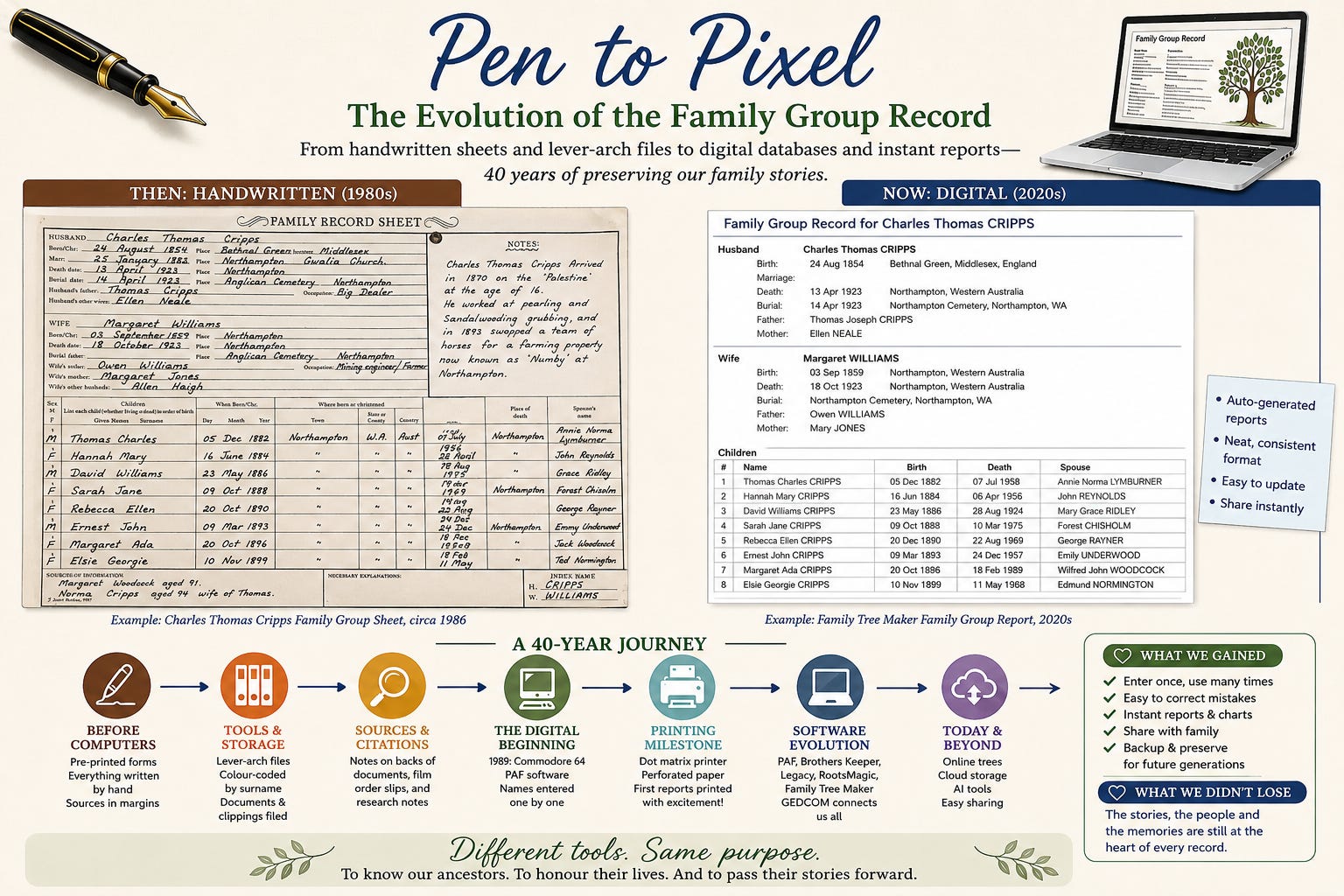
I was sorting through some photos in my Forever storage when I came across one of my original handwritten Family Group Sheets for my great grandfather Charles Thomas Cripps and his family. Looking at it immediately brought back a wave of nostalgia. Then came a sense of pride. I was pretty chuffed to discover that somewhere along the way I had scanned it and preserved it.
That single sheet tells the story of how many of us researched family history before computers became part of everyday life.
My Genealogy Timeline
1986: First Family Group Sheets
1989: First computer (Commodore 64)
1989: Began using PAF (Personal Ancestral File)
Later years: Brother’s Keeper, Legacy Family Tree, RootsMagic
2025: Family Tree Maker + Ancestry sync
Database: 4,988 individuals after 40 years of research
Where It All Began
I began researching my family history in 1986. Forty years ago! It began when myself and friend Donelle, went along to our local school fete and there were two lovely ladies sitting behind a table, promoting the then named, Geraldton Genealogy Society. One lady, Jess, told me I was related to her. Well, that was the start of something bigger than I could ever have imagined.
Back then there were no online trees, no Ancestry hints, no digital archives at the click of a button, and certainly no artificial intelligence. What we did have were Family Group Sheets, pedigree charts, notebooks, filing cabinets, a lot of patience, and not a lot of time as I was working back then and raising a family.
The Family Group Sheets I used were pre-printed forms made available through respected family historian Janet Reakes, who generously shared her knowledge with many beginning researchers. May she rest in peace.
In those early days I had a Family Group Sheet for each of my parents, grandparents and great-grandparents, along with some of their children. It was very much a work in progress.
Every name, date and place was written by hand. I used pencil initially, and only when I was satisfied the information was correct would I carefully write over it in pen.
The forms included space for notes, sources and explanations. When I ran out of room, I simply added another sheet of paper or wrote notes on the back. They became working documents that grew alongside the research.
My filing system was simple but effective. Each family surname had its own colour. Cripps was blue, Lymburner orange, Herbert red and Caddy yellow. I stored everything in foolscap two-ring lever-arch files. Each document was inserted into Marbig Copy Safe foolscap size sheet protectors. I briefly experimented with filing cabinets but quickly discovered they were not for me. I never liked turning my head sideways to read documents. Even today, forty years later, I still use the same colour-coding system.
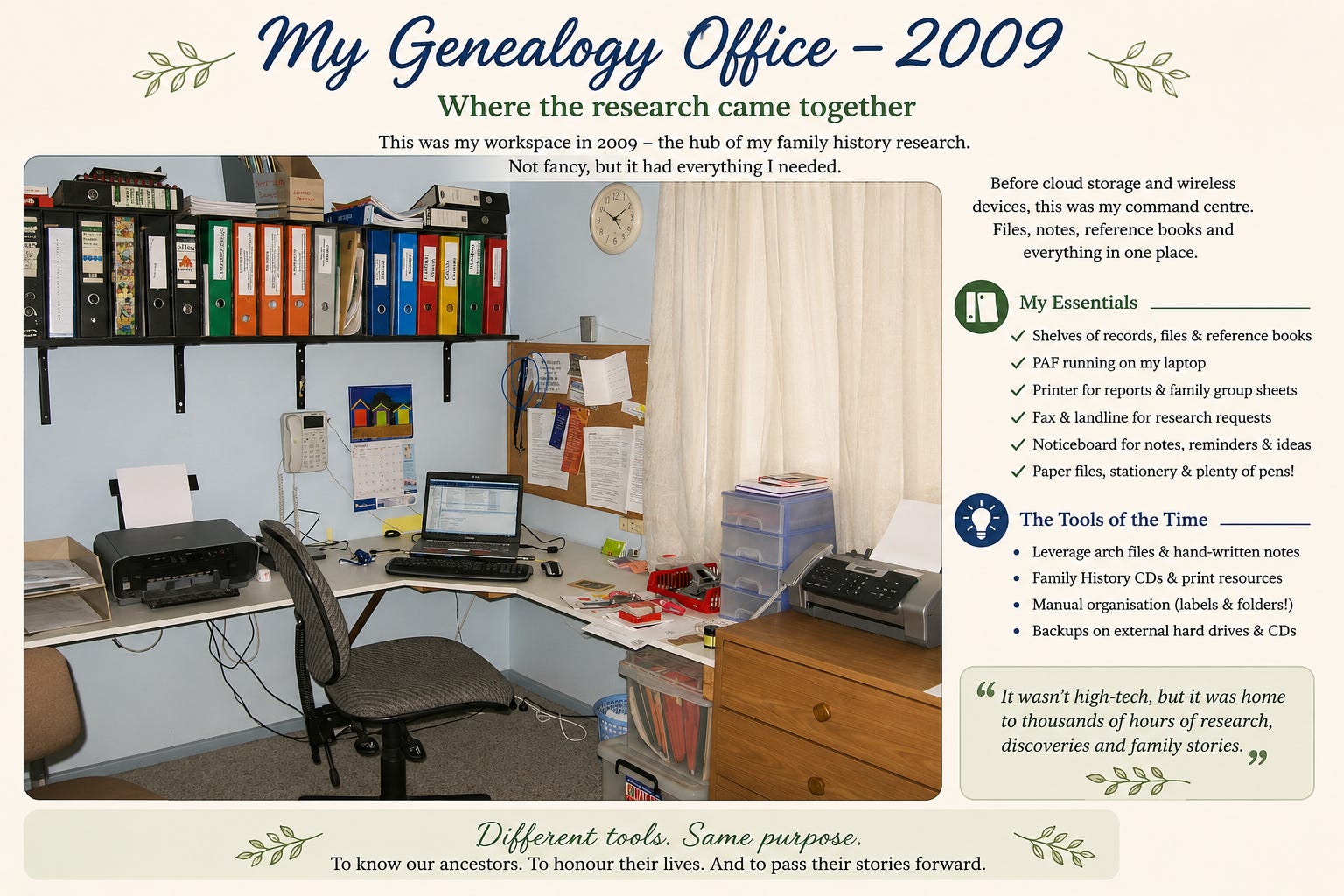
Source citations were not always my strongest point. Looking back, I wish I had been more disciplined. If I obtained a certificate or newspaper clipping, I often wrote details on the back. When I visited the LDS Family History Centre, as it was then known, I kept the film order slips and noted what I was searching for. It wasn’t perfect, but it was the system that worked for me at the time.
From Pencil to PAF
Our first home computer arrived in 1989. It was a Commodore 64, and like many genealogists of the era I was introduced to Personal Ancestral File, better known as PAF, produced by the Church of Jesus Christ of Latter-day Saints. It had been demonstrated to our family history group, and it seemed like the logical next step.
I entered every name manually from my Family Group Sheets. One by one, family by family, I transferred years of handwritten work into the computer. There was certainly a learning curve, but it was a challenge I was willing to embrace.
The real breakthrough came when I realised I only needed to enter a person’s details once. If I linked the correct parents and children, the software could automatically produce Family Group Sheets, pedigree charts and reports. Suddenly I no longer had to write the same names over and over again.
I still remember printing my first reports on a dot matrix printer. The paper fed through on a roller and had perforated edges that had to be torn off afterwards. The printer made an unmistakable rattling and chattering sound as it worked its way across the page, building every letter from a pattern of tiny dots. It may seem primitive today, but at the time I thought it was wonderful. Seeing information appear neatly on paper from something I had entered into a computer was unreal.
Over the years I used several genealogy programs including PAF, Brother's Keeper, Legacy Family Tree, dabbled with RootsMagic and eventually Family Tree Maker. Legacy served me well for many years, but the ability to synchronise directly with Ancestry eventually persuaded me to make the switch.
One of the biggest advances was GEDCOM. For genealogists, it became the bee’s knees. It allowed researchers to move data between programs, although not always perfectly. Certain fields never transferred quite the way you hoped, and some tinkering was usually required. Even today, data migration remains an ongoing challenge.
What Computers Changed
People sometimes ask what was lost when genealogy became computerised. Honestly, I don’t think we lost very much, or anything really. Handwriting could be difficult to read unless care was taken. Computer-generated reports are generally clearer and easier to share.
What we gained was huge. Corrections could be made easily. Reports could be produced instantly. Multiple copies could be printed for relatives. Most importantly, the database structure meant information only needed to be entered once.
Another feature I quickly came to appreciate was the ability to protect the privacy of living people. Rather than having to manually alter a report, most genealogy programs simply let you tick a box to exclude living individuals from the printout. It was a simple idea, but a very useful one when sharing reports. Once the box was ticked, the software did the work for you.
That said, I do think there is value in writing things down. Whether you are writing by hand or typing into a genealogy program, you are engaging with the document. You are reading it, transcribing it and absorbing its contents. That process helps you understand the record rather than simply filing it away.
The Family Group Sheet Lives On
Today my database contains just under 5,000 individuals.
Some genealogists might consider that small after forty years, but I have never been interested in collecting names simply for the sake of it. For me, quality has always been more important than quantity.
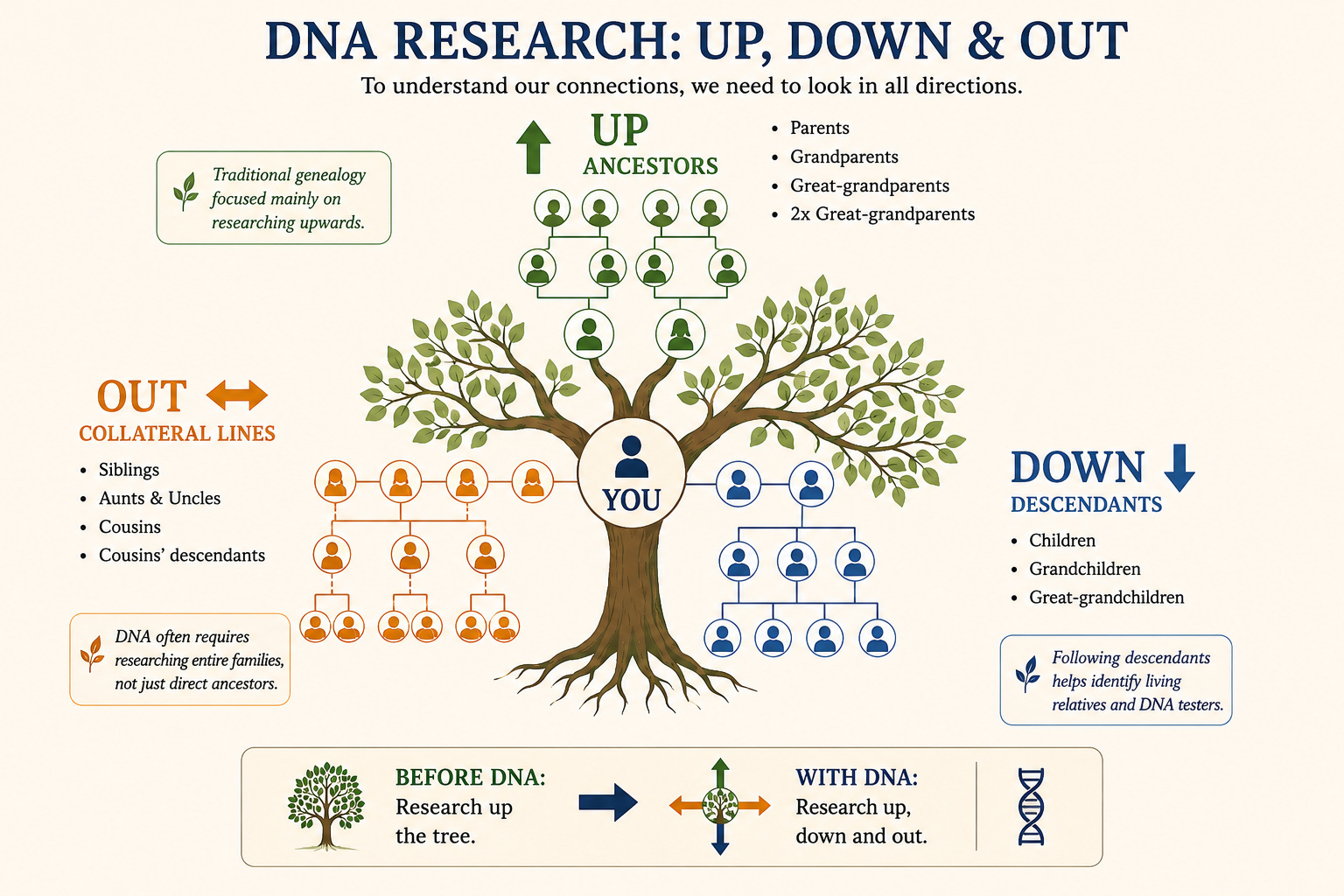
The arrival of DNA has changed that somewhat. These days you can’t just research up and down your direct line. To work out where a DNA match fits, you often need to build families outwards through siblings, cousins and their descendants. Some of the people in my database are there purely because DNA led me in their direction.
My workflow today is very different from 1986. A new document is read, scanned, entered into Ancestry, linked to the appropriate people, cited, synced to Family Tree Maker and then filed. Original paper documents still go into their colour-coded family files, while digital copies are stored in family folders on the computer.
If someone asked me how to begin family history today, I would recommend using genealogy software if they are comfortable with computers. However, I would still encourage them to start by filling out a simple Family Group Sheet with what they already know. There is something powerful about seeing a family laid out on a single page.
Do modern researchers appreciate how much work genealogy required before computers? Probably not entirely. Then again, genealogy is still a lot of work today.
The tools have changed, but the detective work remains the same. Fortunately, we genealogists enjoy the challenge. That’s why we keep doing it.
If I had to choose between a box of handwritten Family Group Sheets and my complete digital database, I would choose the database. In today’s world, it has the best chance of surviving. My children and grandchildren may not want shelves full of lever-arch files, but they will inherit them anyway. Too much effort went into gathering those records to simply throw them away.
Still, every now and then it is worth pulling out an old Family Group Sheet. Not because it contains information I cannot find elsewhere, but because it reminds me where the journey began.
Now to get back to sorting my Forever storage. I digressed to write this article!
This article was written with the assistance of AI. The memories, experiences and opinions are my own, but the idea of using AI as an interviewer to prompt recollections from my genealogy journey was inspired by an article by Carole McCulloch at NextGenGenealogy.
Link: From Memory to Memoir
My Family History Archive is now at WeAre.xyz - Jenealogy Scrapbook
My Memoir Archive is also on WeAre.xyz - Fragments Worth Keeping
I have many handwritten Family Group Sheets. I have got to finish my current work-in-progress, a biography of Edward and Pegeen Fitzgerald so I can get back to family genealogy.
This is absolutely brilliant Jenny! Been there and done most of everything that you talk about. What I miss is the writing and receiving of letters rather than emails. Back when I started,if you shared a common surname with someone you had to write to them and enclose a stamped addressed envelope then wait weeks, or even months for a reply. A lovely trip down memory lane, thank you.